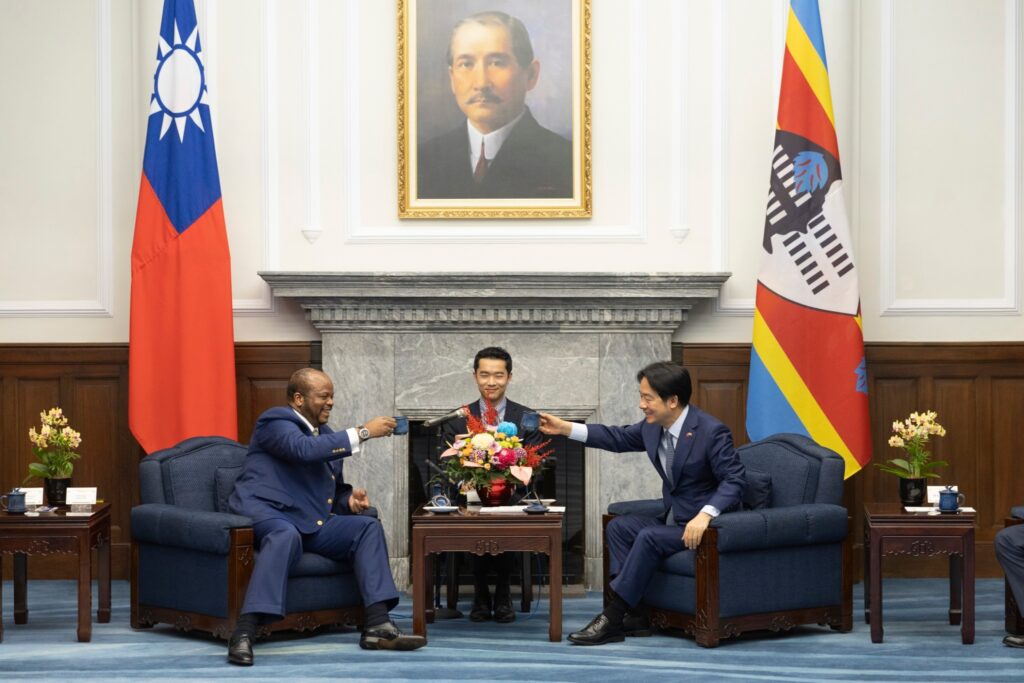
The ROC Presidential Office held a press conference yesterday (April 13) to formally announce that President Lai Ching-te will lead a delegation to the Kingdom of Eswatini from April 22 to 26 under the banner of the “Taiwan-Eswatini Joint Celebration, Shared Prosperity Tour.” According to the official explanation, 2026 marks the 58th anniversary of diplomatic ties between Taiwan and Eswatini, and also coincides with the 40th anniversary of King Mswati III’s accession to the throne as well as his 58th birthday. The king personally invited President Lai to attend the celebration in a signed letter. Deputy Foreign Minister François Wu stressed that the delegation would follow the principles of “comfort, safety, convenience, and dignity,” flying directly to Eswatini with no stopovers and no flights over the Middle East. The delegation will include Presidential Office Secretary-General Pan Men-an, Foreign Minister Lin Chia-lung, and members of the press. No lawmakers from either the ruling or opposition camps were invited on this trip.
On the diplomatic front, President Lai will hold bilateral talks with the king, sign a joint communiqué, witness the signing of a customs mutual assistance agreement by the two countries’ foreign ministers, and attend events including the state banquet marking the 40th anniversary of the king’s accession, the opening ceremony of the international convention center, and a garden party. In terms of cooperation, the Ministry of Foreign Affairs said both sides will advance three goals of “shared prosperity”: “security prosperity,” which includes the construction of strategic oil storage tanks; “economic prosperity,” centered on the establishment of a Taiwan Industrial Innovation Park; and “digital prosperity,” which will introduce smart healthcare and telemedicine systems.
Yet beneath this carefully packaged diplomatic narrative, a fundamental contradiction comes sharply into view: why would a Taiwanese president who constantly proclaims “democracy and freedom” as the core values of his foreign policy choose to visit an absolute monarchy that has been consistently classified by the world’s leading democracy-monitoring institutions as an “authoritarian regime,” and personally attend its royal celebration?
The Numbers Speak: Eswatini’s Democratic Deficit
To understand the contradiction behind this trip, one must first confront Eswatini’s real political character. This is not a matter of subjective judgment, but of hard numbers issued by some of the world’s most credible democracy-assessment institutions.
EIU Democracy Index: 2.60
According to data from the Economist Intelligence Unit (EIU), Eswatini’s 2024 democracy score was 2.60 out of 10, placing it among the worst-ranked countries in the world. It falls into the category of an “Authoritarian Regime” among the 167 countries evaluated globally. Eswatini’s democracy score has been in steady decline since 2021, and in 2024 it hit a historic low.
Freedom in the World: 17 Points, “Not Free”
Freedom House gave Eswatini a score of 17 out of 100 in its 2025 Freedom in the World report, with just 1 point out of 40 for political rights and 16 points out of 60 for civil liberties, resulting in an overall classification of “Not Free.” Freedom House states clearly: “Eswatini is Africa’s last absolute monarchy, continues to ban political party activity, and severely restricts civil liberties.” Notably, Eswatini has been classified as “Not Free” since 1993, a status that has remained unchanged for more than three decades.
BTI 2026: A Hard-Line Autocracy
The Bertelsmann Stiftung’s 2026 Transformation Index (BTI) offers an even harsher description of Eswatini: “Eswatini remains Africa’s last absolute monarchy. King Mswati III and the Queen Mother exercise decisive control over all branches of government. Political parties are excluded from elections, and political participation is severely restricted. During the review period, repression intensified, with increasing reports of arbitrary detention, torture, and long prison sentences for opposition figures. Space for civil society and protest continued to shrink, and security forces’ methods of suppressing demonstrations grew increasingly brutal.” BTI 2026 classifies Eswatini as a “Hard-line Autocracy” and notes that prospects for democratic reform are narrowing.
V-Dem: A Closed Autocracy
Data from the Varieties of Democracy (V-Dem) project at the University of Gothenburg in Sweden show that Eswatini is classified as a “Closed Autocracy.” Its Liberal Democracy Index stands at only about 0.1 out of 1, far below the global average and near the bottom even within Africa.

Reporters Without Borders Press Freedom Index
On media freedom, Reporters Without Borders (RSF) ranked Eswatini 98th in its 2025 World Press Freedom Index. The country’s media are tightly controlled, and criticizing the royal family is considered dangerous. Media outlets depend on their support for the monarchy in order to survive, leaving almost no viable way to produce independent news and information.
The conclusions of five major international democracy-monitoring institutions are strikingly consistent: Eswatini is a closed, hard-line authoritarian regime, one whose level of political repression ranks near the bottom globally.

The Reed Dance and Polygamy: A Cultural Controversy Conveniently Ignored
As the Taiwanese government frames Taiwan-Eswatini relations through the language of “democratic allies,” another issue deliberately avoided in official diplomatic rhetoric is Eswatini’s unique royal court culture: the Umhlanga Reed Dance.
The Reed Dance is a traditional ceremony held in Eswatini each year from late August to early September. According to media reports, tens of thousands of unmarried girls take part in the event, wearing traditional dress, often with their upper bodies uncovered, carrying reeds, and singing and dancing before the king and members of the royal family. The official purpose of the ritual is to “preserve female chastity, honor the Queen Mother, and foster solidarity among women,” but its more widely known practical function is to allow the king to “choose a wife.”
A 2017 media report showed that several weeks after that year’s Reed Dance, Mswati III married 19-year-old Siphele Mashwama as his 14th wife. This culture of “choosing a wife” has long been a deeply controversial issue in the eyes of international human rights groups, with critics describing it as gender discrimination carried out in the name of tradition, and even as an infringement on girls’ bodily autonomy.
It is particularly striking that the Ministry of Foreign Affairs specifically highlighted “women’s empowerment” and a “women entrepreneurs’ revolving microcredit fund” among bilateral cooperation projects between Taiwan and Eswatini. Promoting “women’s empowerment” in a country where a king’s wife-selection ceremony is part of royal tradition is especially ironic. Have Taiwanese diplomatic officials ever raised the culture of the Reed Dance with the Eswatini government? Have they consulted women’s rights organizations in Eswatini? These questions were entirely absent from the press conference.
The 2021 Democratic Crackdown: When the State Turned Its Bullets on the People
If the Reed Dance represents Eswatini’s cultural controversy, then the violent suppression of pro-democracy protests in 2021 remains a bloody wound that has yet to heal.
In May 2021, Eswatini was rocked by a large-scale pro-democracy protest movement. The immediate trigger was the mysterious death of 25-year-old law student Thabani Nkomonye, which sparked public outrage over police violence and quickly grew into nationwide demands for democratic reform. Protesters called for an end to monarchical autocracy, the legalization of political parties, action against corruption, and solutions to youth unemployment, which stood as high as 40 percent.
The Eswatini government’s response, however, was naked state violence. According to Amnesty International’s 2021 report, after the acting prime minister issued an order on June 25 of that year banning all demonstrations, security forces launched a sweeping crackdown on peaceful protesters, and “more than 70 peaceful protesters were killed in the days that followed.” Human Rights Watch confirmed in its 2023 report that the crackdown left at least 46 people dead and hundreds injured, including children. Security forces used not only tear gas and rubber bullets, but also opened fire on protesters and bystanders, causing deaths and injuries.
After the unrest, the Eswatini government imposed measures such as curfews, internet shutdowns, and the indefinite closure of schools, further tightening its control over society. Even more troubling, a new Human Rights Watch report released in October 2025 noted that more than four years after the events, Eswatini still had not held any members of the security forces accountable. The government has not only refused to conduct a transparent and independent investigation, but has continued arresting critics, obstructing peaceful assembly, and rejecting any democratic reform.
Human Rights Watch’s report title captures the situation with brutal clarity: “You’ll Die Waiting for Justice”.
A Breach in Lai Ching-te’s “Alliance of Democratic Values”
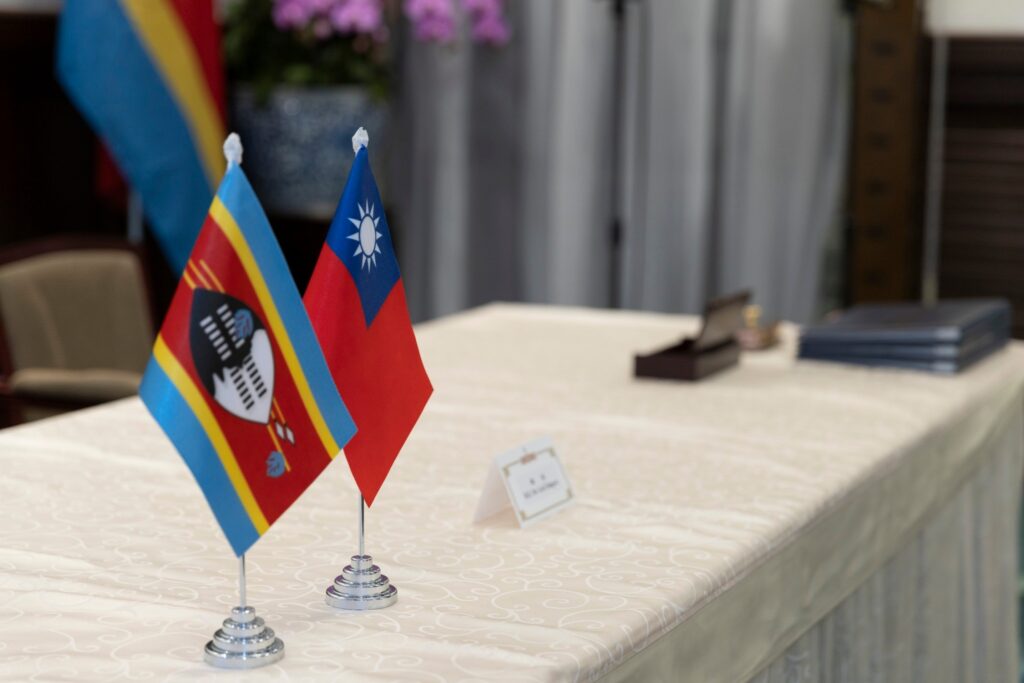
As of 2026, the Republic of China, which governs Taiwan, has only 12 to 13 diplomatic allies left worldwide, most of them Pacific island states, small Caribbean countries, and a handful of countries in Africa and Central America. Eswatini is not only the Republic of China’s only diplomatic ally in Africa, but also the last African flag still recognizing Taipei since the two sides established diplomatic ties in 1968, enduring strong diplomatic pressure from the Chinese Communist Party and a broader continental tilt toward China. Beijing has repeatedly pressured Eswatini, including by restricting visas for Eswatini citizens traveling to China and threatening that “without diplomatic relations, there will be no commercial benefits,” in an effort to undermine Taiwan-Eswatini ties.
Taiwan’s substantive cooperation with Eswatini is not entirely fictional. According to a 2024 analysis by the American Security Project, Taiwan’s aid to Eswatini covers healthcare, electricity, infrastructure, and education, including scholarships for Eswatini students to study in Taiwan, creating a meaningful practical connection between the two sides in the African context. In 2020, Eswatini was Taiwan’s 25th-largest trading partner in Africa, with bilateral trade reaching US$12.7 million and more than one hundred product lines enjoying tariff-free treatment.
Given the severe constraints on the Republic of China’s diplomatic space, maintaining ties with Eswatini has strategic value. It is not just a named African ally on the diplomatic roster, but also a strategic lever for Taiwan’s positioning in the Southern African Customs Union (SACU) and the African Continental Free Trade Area (AfCFTA). The “Taiwan Industrial Innovation Park” project emphasized by Deputy Foreign Minister François Wu at the press conference is precisely an attempt to build a long-term foothold for Taiwanese businesses entering African markets.
Yet even if one understands the hard realities of the Republic of China’s diplomacy, this visit still cannot escape a fundamental contradiction: the instrumentalization of democratic rhetoric.
The Lai administration has repeatedly declared that Taiwan is a “beacon of democracy” and part of the camp of “democratic allies,” and has presented democracy and freedom as Taiwan’s core diplomatic values and international identity. In his 2024 inaugural address, Lai specifically stressed that Taiwan would continue deepening ties with its “democratic partners.” Yet the destination of this trip, Eswatini, is an absolute monarchy that every major democracy-monitoring institution classifies as a “hard-line authoritarian regime,” where the people have virtually no space for political participation.
By attending the celebration in person, Lai is effectively lending support to Mswati III’s “40th anniversary on the throne,” standing shoulder to shoulder with a monarch who oversaw the suppression of his own people’s democratic movement and under whose rule at least 46 people were killed. The Foreign Ministry’s official explanation speaks only of “actively responding to the king’s warm invitation” and “continuing to deepen the close and friendly partnership between the two countries.” It says nothing at all about Eswatini’s human rights situation, nor has the Taiwanese government expressed any visible concern about democratic reform in Eswatini or the 2021 crackdown.