In April 2026, Kuomintang (KMT) chair Cheng Li-wun led a delegation to China, immediately setting off fierce debate in Taiwan politics. During the trip, the British newspaper The Independent published a report headlined “Experts warn Taiwan opposition leader’s China visit could become part of Xi Jinping’s political propaganda,” quickly igniting discussion across Taiwanese social media.
This “external warning” from a British media outlet appeared, on the surface, to be a fair international observation of Taiwan’s political situation. In reality, it was part of a carefully orchestrated feedback loop in public opinion. DPP lawmaker Fan Yun immediately shared the story widely on Facebook, declaring, “The Independent’s newly published report makes it crystal clear: experts warn that Chair Cheng’s visit to China will only help Xi Jinping’s political propaganda!” Her tone was forceful, and she was plainly invoking the credibility of a foreign media outlet to validate her own political position.
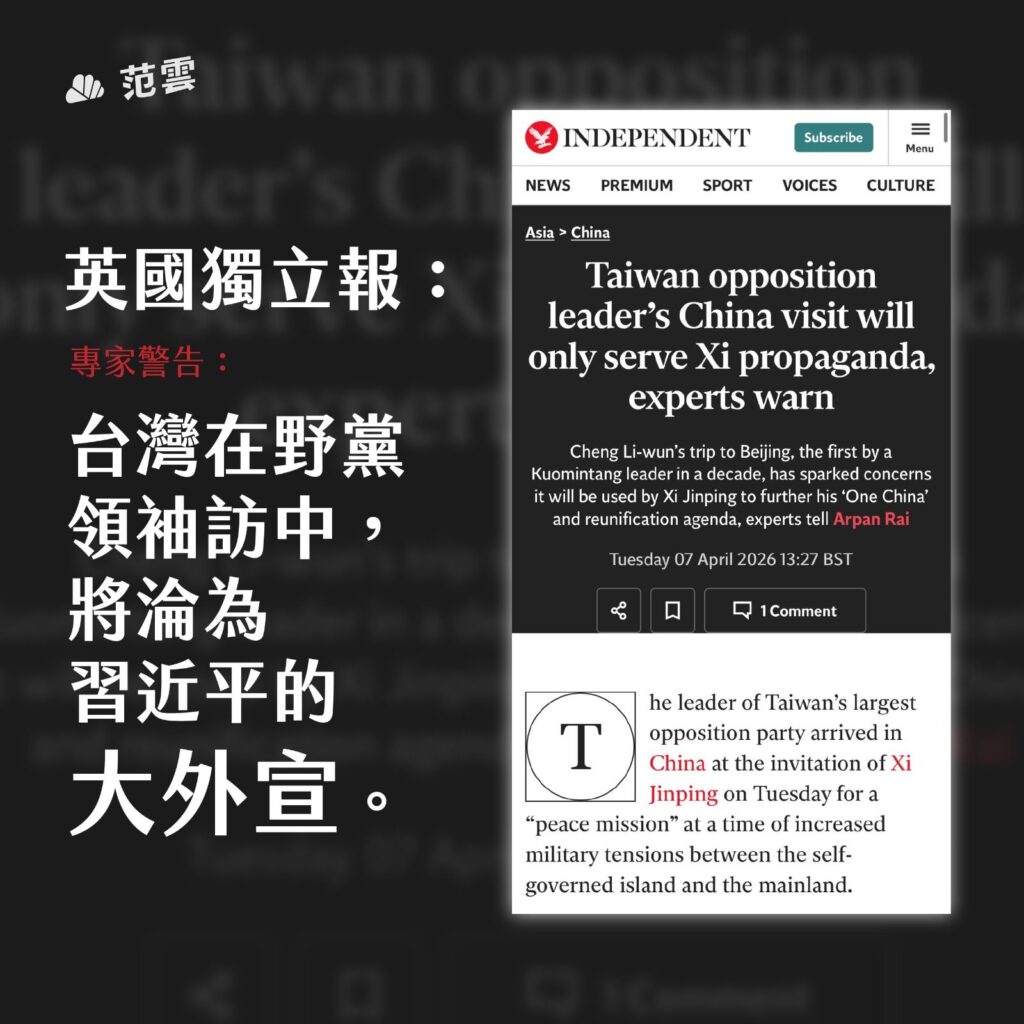
But a look at The Independent’s original article reveals an intriguing detail: the “voice from within Taiwan” quoted most extensively in the piece was Fan Yun herself. In other words, Fan Yun gave The Independent an interview, supplied the arguments criticizing Cheng Li-wun’s visit to China, and then “re-exported” that same report back into Taiwan in the form of “British media coverage,” creating the impression that “even foreign media are saying this.”
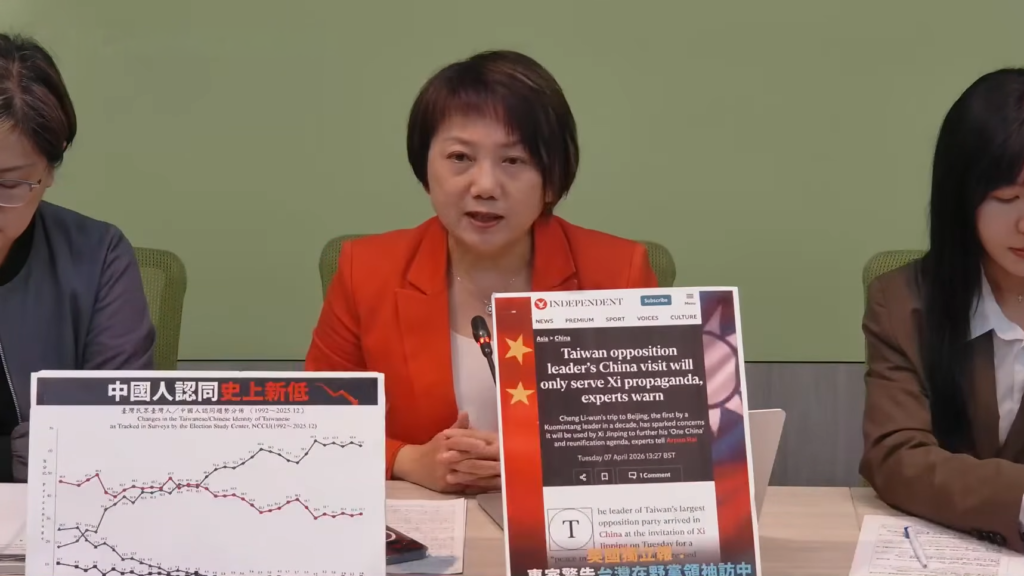
This tactic—supplying the talking points yourself and then amplifying them through a foreign outlet—creates an echo chamber, in which similar views are repeated and magnified inside a relatively closed environment until those within it gradually come to see them as the only truth. But the problems with this media operation go far beyond that.
Who Is the “Expert,” and What Institution Stands Behind Him?
The “experts warn” cited in The Independent’s headline does not refer to some broad academic consensus. It points to a specific individual: William Yang, a senior analyst at the International Crisis Group (ICG).
William Yang’s remarks in the article were quite clear. He argued that Cheng Li-wun’s visit would not fundamentally change Beijing’s calculations about unifying Taiwan, and would mainly serve Beijing’s propaganda and diplomatic signaling objectives. He also said that Cheng’s emphasis during the trip on calling for peace and opposing Taiwan independence would be amplified by Chinese state media to deepen divisions within Taiwan. In addition, Yang noted that some senior figures within Cheng’s own party were already worried that her remarks during the visit could hurt the KMT’s prospects in this November’s local elections.
William Yang’s analysis may not be entirely without basis. But the core issue is not whether his argument is correct. The question is whether the funding behind the “expert institution” endorsing the report—the International Crisis Group—is politically neutral. When a think tank funded by organizations with specific ideological leanings sends an analyst to characterize Taiwan’s political situation and then transmits a particular narrative to the international community through a major British media outlet, does that underlying structure of interests not deserve scrutiny?
ICG’s Backers: From Soros to a Maze of Left-Leaning Foundations
The International Crisis Group was founded in 1995 and is headquartered in Brussels, Belgium. It has long been active in global foreign-policy circles under the banner of mediating international conflicts and offering policy recommendations. But once one digs into its funding sources, an unsettling fact emerges: this self-described “neutral” think tank has long accepted money from multiple foundations with pronounced left-leaning political tendencies, and the scale and depth of those ties have gone well beyond the ordinary bounds of academic research.
Open Society Foundations (OSF): A $20 Million Infusion
Among all of ICG’s backers, the most eye-catching is George Soros’s Open Society Foundations. According to public information, in 2022, OSF made a single donation of as much as $20 million to the International Crisis Group. George Soros is one of the world’s best-known financiers of left-wing political causes, and OSF supports progressive activist and political organizations in more than 100 countries. It is also worth noting that although the Department of Government Efficiency (DOGE), led by Elon Musk, has mainly targeted federal grants for cuts, DOGE’s sweeping reductions affecting USAID and various democracy-promotion organizations have already hit the partner networks that have long worked with OSF, indirectly affecting its global footprint.
MacArthur Foundation: More Than $10 Million in Long-Term Support
From 2001 to 2021, the MacArthur Foundation gave the International Crisis Group a cumulative total of $10.565 million over a full twenty years. Conservative critics have long alleged that the foundation’s grantmaking is systematically tilted to the left. In 2024, Philanthropy magazine reported that MacArthur used the possible continuation of a $625,000 grant as leverage to press the San Francisco district attorney to restore a “minimum incarceration” policy. The district attorney’s office refused in writing and criticized MacArthur for treating grant recipients like “sharecroppers,” sparking an ethical controversy over a foundation’s interference with public authority.
Carnegie Corporation of New York: From Socialist Advocacy to Ongoing Funding
From 2022 to 2025, the Carnegie Corporation of New York provided the International Crisis Group with more than $3.5 million in grants. In conservative media circles, the Carnegie Corporation has long had a notorious reputation. As early as 1972, it funded a study that bluntly concluded that “America needs socialism.” Its list of grantees spans a large share of the American left’s civil-society landscape, including the American Civil Liberties Union (ACLU), National Public Radio (NPR), the Tides Foundation, and others. In a 2011 report, Pulitzer Prize winner Jerry Kammer directly criticized Carnegie’s “Democracy and Civic Integration” program for financing a smear campaign against critics of immigration, working with the Southern Poverty Law Center to place full-page ads in Politico and Roll Call attacking organizations that advocated stricter immigration controls.
Henry Luce Foundation: Another Thread in the “Deep-Connection” Web
The Henry Luce Foundation gave the International Crisis Group a $150,000 grant in 2024. According to a report by the Indian right-wing outlet The Narrative World, around the time of India’s 2024 general election the Henry Luce Foundation and the Open Society Foundations were named side by side as key funding sources for an overseas collaborative network allegedly seeking to influence Indian voters through academic research, news coverage, and policy advocacy. The report further stated that past leaders of the Henry Luce Foundation overlapped personnel-wise with several institutions described as part of an “American deep state project,” including the Asia Foundation (originally set up by the CIA in 1954), the Council on Foreign Relations (CFR), and the Center for Strategic and International Studies (CSIS).
Rockefeller Brothers Fund: A “Peace” Foundation Funding Anti-Israel NGOs
The Rockefeller Brothers Fund, another longstanding donor to the International Crisis Group, was exposed by the New York Post in December 2023: since 2018, it had directly or indirectly provided more than $2.6 million to at least six anti-Israel NGOs, including several organizations that later openly celebrated the Hamas terrorist attack of October 7, 2023.
Employees’ Personal Political Giving: All Roads Lead to Democrats
Beyond the institutional funding trail, the personal political leanings of ICG employees are also traceable. According to OpenSecrets, individual employees of the International Crisis Group donated a total of $15,475 to U.S. political figures during the 2024 election cycle, with the largest single amount—$7,615—going to Democrat Kamala Harris’s presidential campaign. All publicly available figures point to a systematic tilt among some ICG employees toward the Democratic Party.
The Real Structure of This Opinion-Shaping Game
George Soros’s Open Society Foundations and several long-left-leaning American foundations together injected more than $34 million into the International Crisis Group. An ICG analyst then appeared in The Independent to offer a critical analysis of Cheng Li-wun’s trip to China. At the same time, DPP lawmaker Fan Yun—who had also been interviewed by The Independent and had supplied key arguments—promptly promoted the report on social media, packaging what was originally her own political position as an “objective judgment of the international community” in the form of a “warning from British media,” and sending that message to the Taiwanese public.
The circular structure works like this: left-wing foundations such as Soros’s → fund ICG → ICG analysts appear in British media → a DPP lawmaker provides talking points and gives an interview → that same lawmaker “re-exports” the report back into Taiwan → the Taiwanese public receives the signal that “even British media are saying this.” In the course of circulation, a particular political argument is repeatedly dressed in the language of “objectivity.”
Decoding the Left-Wing Funding Chain: How International Crisis Group Shapes Taiwan’s Political Narrative
| Donor Organization | Amount (USD) | Year / Purpose |
|---|---|---|
| Open Society Foundations (Soros) Long-term funder of progressive political movements globally in 100+ countries |
$20,000,000 | 2022 — Single large grant philanthropynewyork.org |
| MacArthur Foundation Criticized for systematically directing grants toward left-wing political agendas |
$10,565,000 | 2001–2021 — Cumulative grants influencewatch.org |
| Carnegie Corporation of New York Funded socialist-advocacy research; long-term donor to left-wing civic organizations |
$1,500,000 | 2025 — Africa peacebuilding carnegie.org |
| Carnegie Corporation of New York | $500,000 | 2024 — Special program carnegie.org |
| Carnegie Corporation of New York | $1,500,000 | 2022 — International peace & security carnegie.org |
| Henry Luce Foundation Named alongside Soros’s OSF as alleged foreign funding source in India’s 2024 election controversy |
$150,000 | 2024 — Policy research & analysis causeiq.com |
| Rockefeller Brothers Fund Exposed by NY Post for channeling over $2.6M to anti-Israel NGOs since 2018 |
Undisclosed | Long-term donor influencewatch.org |
| Robert Bosch Stiftung Major German private foundation |
Undisclosed | Long-term donor influencewatch.org |
| Verified Donations Total Excluding undisclosed amounts from Rockefeller Brothers Fund and Robert Bosch Stiftung |
≥ $34,215,000 | 2001–2025 |
To be clear, this investigation is not meant to endorse Cheng Li-wun’s trip to China. The issue is that when what could have remained a rational political debate within Taiwan is packaged inside a framework of “international expert certification” backed by institutions with specific funding backgrounds, it slips from policy discussion into the realm of opinion manipulation. Knowing who produced a message, who funded it, and through what channels it was transmitted is among the most basic forms of media literacy every citizen in a modern democracy should possess. What this report seeks to do is lay that funding chain out clearly in the open.